“Does social media work for luxury brands?”
In our experience, yes.
In fact, nearly a third of global luxury sales are expected to take place online by 2025.
And with millennials twice as likely to say, “when a brand uses social media, I like that brand more”, according to a consumer sentiment study, it’s becoming almost impossible for luxury brands to resist the pull of social media.
In this guide, we’ll show you why social media works for luxury brands and how you can navigate through the platforms for the best results.
For example, a luxury homeware brand recently earned an 18.23X return on their ad spend through strategic social media marketing.
To understand how to get similar results, read on.
Recommended Social Media Platforms for Luxury Brands
Social media marketing for luxury brands differs from marketing everyday brands for one main reason: Luxury brands exude exclusivity, craftsmanship, heritage, and higher prices signal superior quality.
Thus, any social media marketing strategy for a luxury brand must revolve around creating an exclusive lifestyle. As Deloitte’s analysis suggests, “the focus of luxury marketing may be less on selling items and more on creating a value-added customer experience based on brand storytelling.”
With social media marketing for luxury brands, it’s crucial to create content that’s entertaining, current, and stimulates engagement.
To achieve this, utilize a “4-pillar strategy” to create a balanced mix of content that educates, inspires, promotes, and entertains.
85% of luxury consumers use social media, each engaging with an average of three platforms. So, which platforms should your brand prioritize?
Instagram is ideal for sharing user-generated content and collaborating with influencers and experts, as many LVMH maisons have demonstrated throughout recent times with original and relatable features. This content can also be easily cross-posted to other social channels.
Posting Stories and Instagram Reels is highly effective for capturing attention and showcasing the aspirational lifestyle your brand offers. Kenzo’s Reels, for example, share both lifestyle imagery and promote causes important to them, such as tiger conservation with the WWF.
Facebook’s segmentation capabilities are unparalleled, allowing you to pinpoint precisely the right audience for your marketing efforts. This is perfect for targeting the ultra-specific groups that luxury brands desire.
As Facebook owns Instagram, sharing your images and videos across both platforms is seamless. With a well-structured Facebook ads campaign, you can achieve a significant return on your ad spend for a relatively small cost.
YouTube
YouTube is a dominant platform, perfect for sharing longer video content. Brands can work with influencers or an in-house team to create organic content for their channel, or focus entirely on producing content through influencer channels.
For instance, you could collaborate with influencers to feature your brand in shopping hauls, or simply showcase a luxury outfit or service in a video as a form of product placement.
YouTube’s ad platform is also excellent for displaying ads to specific target markets, such as advertising luxury Italian food and wines to users who have watched many Italian travel videos.
Pinterest is a visual-rich platform offering both paid and organic ways to share content. With 59% of millennials discovering products through Pinterest (on par with Instagram), it’s a platform luxury brands cannot afford to overlook.
As a visual discovery platform, many users turn to Pinterest to find new products and plan future events. Users are highly likely to save images of products they intend to buy, for example, curating an entire outfit for an event through a Pinterest board. Moreover, Pinterest drives more shopping traffic than any other platform.
Crucially, Pinterest’s positive impact on user sentiment aligns perfectly with luxury brand marketing objectives. The more Pinterest’s affluent audience creates boards featuring your products, the better for your brand.
Examples of Luxury Brands on Social Media
Research indicates that 13 factors influence customer interaction with luxury brands on social media, ranging from aesthetic motives to status signaling. Above all, luxury products signal superior quality, demanding superior content.
It’s essential to pay meticulous attention to content quality, ensuring nothing less than stellar is published. A luxury brand’s image is paramount and cannot be tarnished by weak content. From Tiffany & Co’s “Believe in Dreams” campaign to Christian Louboutin’s “#WishUponAStar”, content should aim to stimulate fantasies of a higher social status and a better life.
It’s a demanding task, but many brands excel at it. By bridging the gap between brand and customer, they create content that allows customers to imagine how owning the brand’s products would elevate their sense of being.
Here’s a selection of compelling luxury social media content examples:
Video examples
Most luxury advertising isn’t focused purely on conversion. It’s about showcasing a lifestyle or the feelings associated with it, hence the more artistic video advertisements for high-end colognes or cars. Video is an unmatched medium for this.
Rolex’s YouTube channel, for instance, shares high-production-value videos that amplify the luxury lifestyle they offer, alongside helpful how-to videos for Rolex owners.
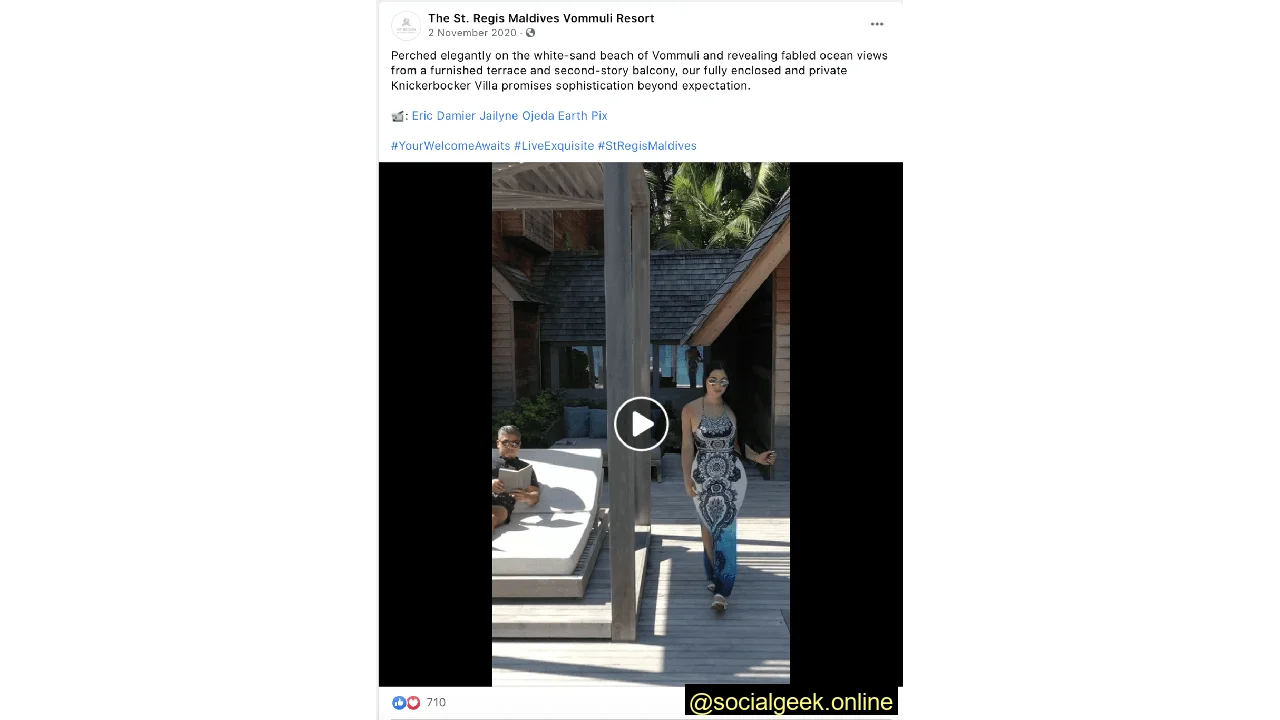
This video, live from the Maldives, encapsulates the essence of staying at the St. Regis Vommuli Resort. From the architecture to the pool to the beachfront view, it presents it all without a single word, in just 13 seconds. The almost effortless aesthetic is a significant part of its appeal.
Social proof is a huge factor in luxury advertising. Big brands like Gucci use celebrity endorsements. Smaller brands, like 001 London, can leverage social proof through reviews and showcasing awards, as they effectively do.
Image examples
Through images alone, you can convey feelings of luxury via composition, color palette, photography quality, and, of course, the subject matter and scenery. Instagram is an unparalleled platform for showcasing such visuals.
If you’re living a luxury lifestyle, you might enjoy Veuve Clicquot at lunchtime. In this context, the bottle isn’t the primary focus; rather, it’s the food on the table and the story it tells. A picture of the bottle alone would not evoke these feelings of luxury. The accompanying description further paints the picture by stimulating sensations related to the display.
Bold colors and compelling composition differentiate this advertisement from typical model snapshots, making it stand out.
Creed illustrates that their cologne is more than just a product; it’s a concept, a lifestyle, and a story encapsulated in one. You’re not merely acquiring a pleasant scent; you’re experiencing the essence of Norway.
Carousel Examples
Carousels effectively combine emotionally rich and evocative imagery with more practical, close-up product views.
For example, Tiffany & Co shares an artistic, lifestyle-focused video ad showcasing an entire collection alongside individual photos of each product within that collection. This is an excellent method to bridge the emotional impact of an ad directly to a purchase.
Selfridges utilizes a carousel to display a themed collection of products, such as beauty items under their “alfresco adventures” theme. They employ a mix of magazine-style advert spreads and detailed product shots.
Carousels also serve as a versatile way to demonstrate products in various applications. Corston Architectural Detail, for instance, showcases their collection of brass products as they would appear in a modern interior setting.
Facebook Ad Strategies For Luxury Brands
Before recent global events, 90% of luxury sales occurred through physical stores. With most physical locations experiencing closures, these brands have increasingly relied on digital marketing—particularly Facebook.
However, exclusivity is fundamental to luxury brand marketing. If a Louis Vuitton handbag were readily available in any high-street store, its appeal would diminish. Therefore, a mass campaign might not be suitable; in fact, viral marketing for luxury brands could even be detrimental.
To cultivate this exclusivity online, brands can implement private member groups, concierge services, or digitally-delivered loyalty perks and programs specifically reserved for previous customers.
Implementing Facebook ad strategies for luxury brands requires a nuanced approach, often involving targeting very specific groups of people.
Facebook Ad Targeting Options For Luxury Brands
Facebook ads are among the most effective forms of online advertising, largely due to their highly sophisticated level of segmentation and targeting. For example, you could target married women over 40 in Milan who like Prada and Versace. You can further refine this by targeting people based on their education, workplace, job title, and more.
Precise targeting is vital for a luxury brand marketing strategy. Marketing to everyone can dilute the brand’s image and potentially create undesired associations.
It is recommended to segment your Facebook Ad Sets into different audience pockets, considering the levels of intent people have shown towards luxury products.
Luxury interests
It’s crucial to remember that luxury products are not necessities; they fall under “wants” rather than “needs.” People purchase these products to treat themselves, not out of essential requirement.
Because of this, the more somebody engages with luxury goods or interests related to a luxury lifestyle (e.g., yachting), the more likely they are to purchase luxury products.
Luxury brands
You can target customers based on their stated interests in specific brands. This is perfect for attracting customers who have shown interest in brands with a similar price point and style to yours.
For example, users interested in Gucci are very likely to also be interested in Dior.
This strategy works exceptionally well for drink and cosmetics brands. If you’re advertising a high-quality gin, you can target customers who have shown interest in similar gin brands or other premium spirits like vodka or tequila. An interest in these other brands suggests a willingness to explore similar quality offerings.
Income-based
This targeting method is primarily applicable to US-based audiences. It allows you to target customers by household income. This is highly effective if you have data indicating the income brackets of your most loyal and highest-spending customers.
With this method, you can target specific income percentages, such as the top 10% of highest earners.
Lookalikes
A lookalike audience is a new audience segment that shares significant similarities with your existing customers. Facebook creates these audiences by leveraging insights from your current customer base and identifying new audiences likely to become customers.
It’s recommended to begin with 1% lookalike audiences when starting a campaign. Once successful with that size, you can build additional ad sets with 1-2%, and continue scaling until performance no longer justifies further expansion.
Broad Audiences
A broad audience is an audience with no specific interests or custom audiences built into the ad set. This approach allows Facebook’s machine learning to efficiently search for customers actively in the market for the products you sell.
For example, a broad audience campaign (e.g., 18-65+ male and female) has shown excellent results. A top-of-funnel (TOFU) campaign achieved a 6.37 return on ad spend (ROAS), and an ‘all of funnel’ (AOFU) campaign delivered an impressive 24.17 ROAS.
For the AOFU / Broad Audience ad set, the only exclusion to include is 30-day website visitors.
How to Structure Your Luxury Brands Facebook Ad Campaign
To begin, envision your entire campaign as a funnel.
At the top are prospects with limited brand awareness, in the middle are those who engage with your content, and at the bottom are those most likely to purchase. The lower the intent behind a search, the higher in the funnel they will be, and vice versa.
For a campaign to be effective, you must present appropriate content for each stage of the funnel, matching the prospect’s demonstrated level of intent.
This means brand awareness-style content for the top of the funnel, and content that encourages sales and/or links to sales pages closer to the bottom.
Here’s how a typical funnel structure looks:
On the left is the stage of the funnel, and on the right is the typical audience identifier for that stage.
|
Stage of funnel |
Identifier |
|
All of funnel |
Broad Audience |
|
Top of funnel |
Lookalikes Interest audiences |
|
Middle of Funnel |
Custom audiences Social engagers Video viewers All website visitors |
|
Bottom of funnel |
Product page visitors Dynamic carousel users |
To ensure content aligns with the prospect’s intent level, include appropriate exclusions at each funnel stage. Here are the recommended exclusions:
|
Stage of funnel |
Exclusions |
|
All of funnel |
Website Visitors: 30 days |
|
Top of funnel |
Website Visitors: 30 days |
|
Middle of Funnel |
Add To Cart: 30 days |
|
Bottom of funnel |
Purchasers: 30 Days |
How frequent to advertise to each stage
Luxury brands typically have a higher average order value, and purchases are often not made impulsively. As such, more touch points with the prospect are generally required.
Here are the recommended ad frequencies:
|
Stage of funnel |
Frequency per month |
|
Top of Funnel |
2 to 3 |
|
Middle of Funnel |
5 to 6 |
|
Bottom of Funnel |
8 to 10 |
Once you’ve reached a point where conversion campaigns are optimized, consider adding Top-of-Funnel (TOFU) brand awareness content. This can fill the Middle-of-Funnel (MOFU) with video views and engagement campaigns, expanding your marketing reach and building your brand long-term.
By adopting this approach, you can also effectively scale your campaigns across other core social media platforms.
Recommended Monthly Ad Budget For Luxury Brands
When setting your ad budget, four key points should be taken into consideration:
- The cost of your product or service.
- Your average order value (AOV).
- The number of customers you aim to acquire.
- Your profit margins per product.
For instance, if your product is valued at £1000 with a profit margin of £500 per sale, you would ideally start with at least £500 per day in Facebook ad spend.
Typically, you should aim to spend at least 1x the margin you’d make from a single sale. Otherwise, your budget might be too small, making it difficult to gain valuable insights from your campaigns efficiently.
Spending too little can also lead to excessive volatility in your campaigns, potentially resulting in days without sales and insufficient data to identify issues or optimize effectively.
Facebook itself recommends spending enough to achieve 50 purchases per ad set. This helps you exit the learning phase quickly and reduces volatility.
Getting The Best Results For Your Luxury Brand with Social Media
Achieving optimal results with social media marketing, especially for luxury brands, demands strategic expertise. There’s no room for guesswork; a deep understanding of what works, and more importantly, why, is crucial. Without this knowledge, you risk inefficient spending on ineffective campaigns, without the ability to diagnose or correct issues.
For instance, leveraging Facebook advertising expertise, a jewelry brand achieved a 2500% increase in average monthly orders. This was accomplished by developing a paid social strategy based on a full-funnel approach, utilizing existing creative assets, and creating highly converting video creatives for Facebook and Instagram. This strategic effort resulted in a 4.3 ROAS.
Similarly, a subscription box service, new to Facebook advertising, saw over 10,000 new subscribers and a 3.24 ROAS after implementing a tailored funnel, content creation, and ad copy split testing. This significantly surpassed their goal of 2.5, enabling sustainable business growth.